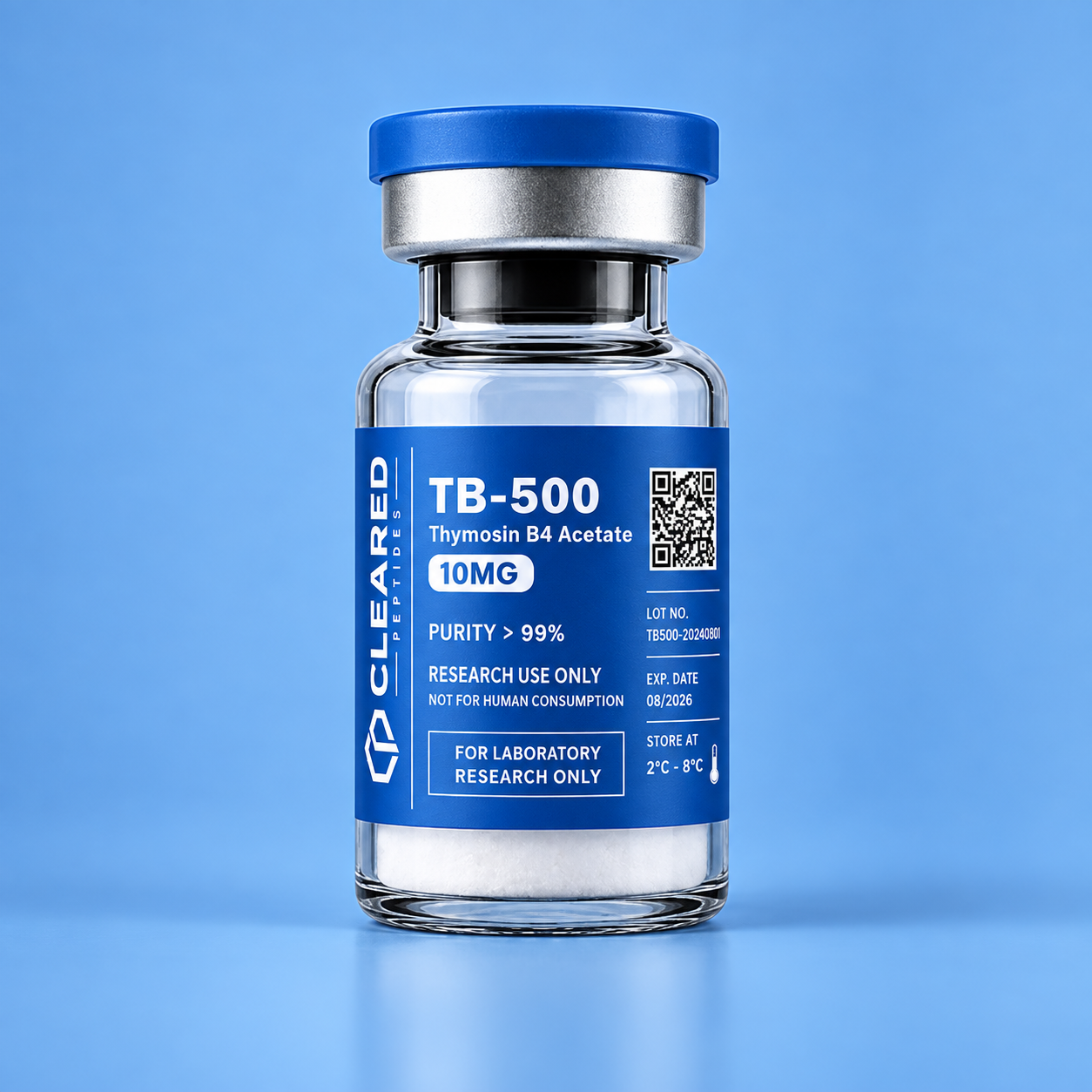
TB-500 (Thymosin Beta-4) – Research Grade
TB-500 (Thymosin Beta-4) from Cleared Peptides is a research-grade compound supplied for laboratory and analytical investigation. Every lot is third-party tested, and the batch Certificate of Analysis is published before sale. Specifications, CAS number and molecular formula are listed below.
Research use only. TB-500 (Thymosin Beta-4) is supplied for laboratory research. It is not a drug, food, cosmetic, or dietary supplement. It is not FDA-approved. It is not for human or veterinary administration. This page does not give a dose or a method of administration. A study cited on this page describes that study’s own test article. It does not make this lot an approved medicine. To check a fact, open the PubMed or DOI link, confirm the authors and year, and match the paper’s compound name, CAS number, or sequence to the specification table. The full method is on the research desk page. Identity and purity for a lot are only what that lot’s certificate of analysis reports. An HPLC percentage is not a sterility result and not an endotoxin result unless the certificate prints those tests.
TB-500 Specifications
| Compound | Thymosin Beta-4 (TB-500) |
|---|
| Synonyms | Tβ4; Thymosin β4 acetate |
|---|
| CAS Number | 77591-33-4 |
|---|
| PubChem CID | 16132341 |
|---|
| Molecular Formula | C212H350N56O78S |
|---|
| Molecular Weight | 4963.4 g/mol |
|---|
| Sequence / Structure | 43-amino-acid peptide (N-terminal acetylated) |
|---|
| Form | Lyophilized (freeze-dried) powder |
|---|
| Purity | ≥99% by HPLC (verified per batch – see COA) |
|---|
| Storage | Store at −20 °C, sealed, dry and protected from light. Allow vial to reach room temperature before opening. |
|---|
Thymosin Beta-4 / TB-500 in Published Research
Thymosin Beta-4 (Tβ4) is a 43-amino-acid, N-terminally acetylated peptide and one of the most abundant intracellular actin-sequestering proteins. Research suppliers commonly list the full-length peptide under the name TB-500.
In laboratory studies Tβ4 is used as a reference compound for G-actin binding and cytoskeletal dynamics, and in cell-migration, angiogenesis-signaling and extracellular-matrix assays. Its LKKTETQ actin-binding motif is a common subject of structure–function work.
This summary describes published laboratory research only and makes no claim about effects in humans or animals.
Purity Testing & Certificate of Analysis
Each lot of TB-500 is analyzed by an independent laboratory, with identity and purity (or composition, for multi-component preparations) reported on a lot-specific Certificate of Analysis. View current results on our COA page.
Storage & Laboratory Handling
Store at −20 °C, sealed, dry and protected from light. Allow vial to reach room temperature before opening. Minimize freeze–thaw cycles and handle according to your institution’s chemical-hygiene procedures.
Frequently Asked Questions
Is TB-500 the same as Thymosin Beta-4?
TB-500 is the name research suppliers commonly use for Thymosin Beta-4. Our product is the 43-residue acetylated peptide (CAS 77591-33-4); identity is confirmed by mass spectrometry on each lot COA.
Is TB-500 third-party tested?
Yes. Every lot of TB-500 is tested by an independent laboratory for identity and purity, and the batch Certificate of Analysis is published on our COA page.
Can I see the TB-500 Certificate of Analysis before ordering?
Yes. Lot-specific COAs are posted on our COA page so you can review analytical data before purchase.
What does Research Use Only (RUO) mean?
RUO products are supplied solely for laboratory and analytical research. They are not medicines, are not for human or veterinary use, and no dosing or administration information is provided.
How should TB-500 be stored?
Store at −20 °C, sealed, dry and protected from light. Allow vial to reach room temperature before opening.
Research Guides
Learn more: TB-500 (Thymosin Beta-4) research guide · BPC-157 vs TB-500 comparison
Written by the Cleared Peptides Research Desk, the editorial desk of Cleared Wellness Group LLC. This is not a personal profile of a physician or a scientist, and it is not a fictional author. The checking method is public on the research desk page. Last reviewed October 2026.
TB-500 research note: this specification is full-length thymosin β4
Research use only. This TB-500 material is specified as thymosin β4 for laboratory research, CAS 77591-33-4. It is not a drug, and the tissue-repair literature is not a dosing guide.
The purchasing error this field actually makes
Two different molecules circulate under overlapping nicknames. One is the 43-residue protein thymosin β4. This catalog’s table specifies that protein: N-terminally acetylated, formula C212H350N56O78S, mass about 4963.4 g/mol, CAS 77591-33-4. The other is a short synthetic fragment built on the actin-binding motif LKKTETQ, often sold acetylated. The fragment is not a rounding error of the protein. A mass spectrometer separates them immediately. A certificate that reports the fragment mass does not confirm this specification, and a certificate that reports 4963 does not confirm the fragment.
Safer, Elzinga, and Nachmias (Journal of Biological Chemistry, 1991) reported that thymosin β4 and the actin-sequestering peptide Fx are the same molecule. That paper is about the protein, not about a seven-residue fragment. PubMed 1999398. Goldstein, Hannappel, and Kleinman (Trends in Molecular Medicine, 2005) review the later literature in which the actin-sequestering protein is also discussed in tissue injury. The review is not a certificate, and its repair language belongs to the studies it cites. PubMed 16099219, DOI 10.1016/j.molmed.2005.07.004.
Actin sequestration is the mechanistic core a reader can check without borrowing clinical language. Thymosin β4 binds monomeric actin and holds a reserve of G-actin. Papers that jump from that biochemical fact to an instruction for a person have left the evidence. This page stops at the biochemical identity.
What the certificate has to show
Identity is a mass consistent with the acetylated 43-residue chain, including the single sulfur in the formula. Area-percent HPLC purity still ignores water and acetate. N-terminal acetylation changes the mass by 42 units relative to the free amino terminus. A close but unacetylated mass is a related species, not an automatic pass. The method is the same one described in the analytical testing guide.
How to verify this note
- Open Safer 1991 and confirm the subject is thymosin β4, the actin-sequestering protein.
- Match CAS 77591-33-4 and mass about 4963.4 g/mol. Reject a LKKTETQ fragment mass as proof of this item.
- Read Goldstein 2005 as a review. Read the certificate as the lot record.
Selected References
Peer-reviewed literature on TB-500 (Thymosin Beta-4), listed as scientific background for laboratory researchers. Citation does not imply endorsement by the authors or any use other than in-vitro research.
- Nachmias VT. Small actin-binding proteins: the beta-thymosin family. Curr Opin Cell Biol. 1993;5(1):56-62. PubMed 8448031 · DOI
- Dedova IV, et al. Thymosin beta4 induces a conformational change in actin monomers. Biophys J. 2006;90(3):985-92. PubMed 16272441 · DOI
Related Research Compounds
Research Use Only
For laboratory research use only. This product is not a drug, food, cosmetic or dietary supplement, is not FDA-approved, and is not intended for human or veterinary use or for the diagnosis, treatment, cure, mitigation or prevention of any disease. No dosing, administration or therapeutic information is provided. Sold only to qualified researchers; the purchaser is responsible for safe handling and compliance with all applicable laws and institutional requirements.