
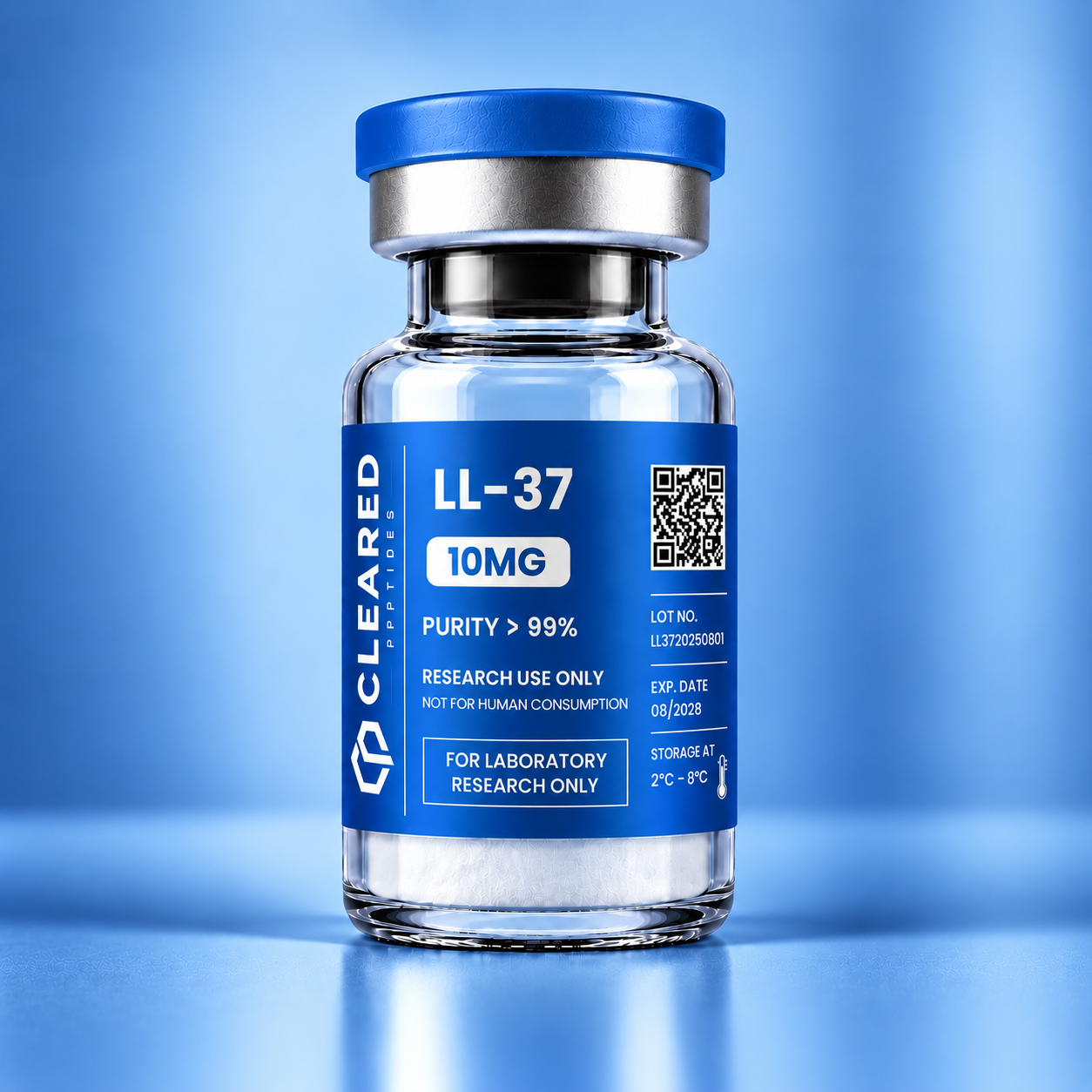
LL-37
Original price was: $75.00.$52.00Current price is: $52.00.
Discount per quantity
| Quantity | 2 | 3 | 4 | 5 | 10 - 15 |
|---|---|---|---|---|---|
| Price | $46.80 | $44.20 | $41.60 | $39.00 | $36.40 |
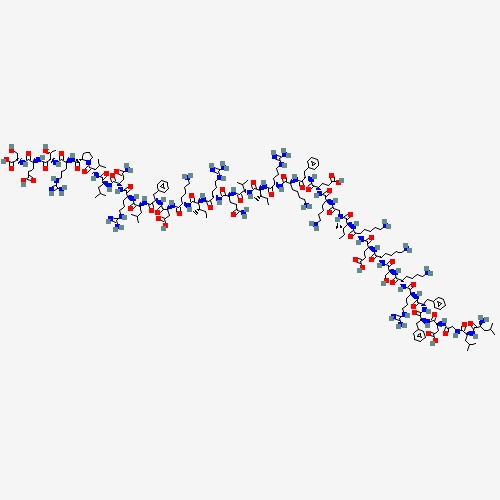
Molecular Structure Explorer
LL-37
Structure of the compound on this page.
Product Details
LL-37 – Research Grade
LL-37 from Cleared Peptides is a research-grade compound supplied for laboratory and analytical investigation. Every lot is third-party tested, and the batch Certificate of Analysis is published before sale. Specifications, CAS number and molecular formula are listed below.
Research use only. LL-37 is supplied for laboratory research. It is not a drug, food, cosmetic, or dietary supplement. It is not FDA-approved. It is not for human or veterinary administration. This page does not give a dose or a method of administration. A study cited on this page describes that study’s own test article. It does not make this lot an approved medicine. To check a fact, open the PubMed or DOI link, confirm the authors and year, and match the paper’s compound name, CAS number, or sequence to the specification table. The full method is on the research desk page. Identity and purity for a lot are only what that lot’s certificate of analysis reports. An HPLC percentage is not a sterility result and not an endotoxin result unless the certificate prints those tests.
LL-37 Specifications
| Compound | LL-37 |
|---|---|
| Synonyms | Human cathelicidin antimicrobial peptide |
| CAS Number | 154947-66-7 |
| PubChem CID | 16198951 |
| Molecular Formula | C205H340N60O53 |
| Molecular Weight | 4493.3 g/mol |
| Sequence / Structure | 37-amino-acid peptide (LLGDFFRKSKEKIGKEFKRIVQRIKDFLRNLVPRTES) |
| Form | Lyophilized (freeze-dried) powder, 5 mg per vial |
| Purity | ≥99% by HPLC (verified per batch – see COA) |
| Storage | Store at −20 °C, sealed, dry and protected from light. Allow vial to reach room temperature before opening. |
LL-37 in Published Research
LL-37 is the 37-amino-acid active fragment of human cathelicidin (hCAP18), named for its two N-terminal leucines.
It is a reference antimicrobial peptide studied in membrane-disruption, biofilm and innate-immunity signaling research.
This summary describes published laboratory research only and makes no claim about effects in humans or animals.
Purity Testing & Certificate of Analysis
Each lot of LL-37 is analyzed by an independent laboratory, with identity and purity (or composition, for multi-component preparations) reported on a lot-specific Certificate of Analysis. View current results on our COA page.
Storage & Laboratory Handling
Store at −20 °C, sealed, dry and protected from light. Allow vial to reach room temperature before opening. Minimize freeze–thaw cycles and handle according to your institution’s chemical-hygiene procedures.
Frequently Asked Questions
Is LL-37 third-party tested?
Yes. Every lot of LL-37 is tested by an independent laboratory for identity and purity, and the batch Certificate of Analysis is published on our COA page.
Can I see the LL-37 Certificate of Analysis before ordering?
Yes. Lot-specific COAs are posted on our COA page so you can review analytical data before purchase.
What does Research Use Only (RUO) mean?
RUO products are supplied solely for laboratory and analytical research. They are not medicines, are not for human or veterinary use, and no dosing or administration information is provided.
How should LL-37 be stored?
Store at −20 °C, sealed, dry and protected from light. Allow vial to reach room temperature before opening.
Written by the Cleared Peptides Research Desk, the editorial desk of Cleared Wellness Group LLC. This is not a personal profile of a physician or a scientist, and it is not a fictional author. The checking method is public on the research desk page. Last reviewed October 2026.
LL-37 research note: the mature human cathelicidin peptide
Research use only. This LL-37 material is for laboratory research, CAS 154947-66-7. It is not an antibiotic drug, and an antimicrobial result in a paper is not a sterility test of this vial. This page does not give a dose or a method of administration.
Gene, precursor, mature peptide
Gudmundsson, Agerberth, Odeberg, and colleagues (European Journal of Biochemistry, 1996) characterized FALL39, the only cathelicidin gene they found in the human genome. Exons 1–3 encode the signal and the cathelin region. Exon 4 encodes the mature antibacterial peptide. They isolated that mature peptide from granulocytes. The precursor is longer than the peptide. A mass for hCAP-18, the precursor, does not confirm LL-37, and the reverse is also true. PubMed 8681941, DOI 10.1111/j.1432-1033.1996.0325z.x.
Dürr, Sudheendra, and Ramamoorthy (Biochimica et Biophysica Acta, 2006) review LL-37 as the only human cathelicidin peptide: 37 residues, amphipathic helix, discussed both as an antimicrobial peptide and as a modulator of innate immune cells. The review is biophysical and immunological background. It is not a certificate. PubMed 16716248, DOI 10.1016/j.bbamem.2006.03.030.
The catalog sequence is LLGDFFRKSKEKIGKEFKRIVQRIKDFLRNLVPRTES, formula C205H340N60O53, mass about 4493.3 g/mol. The name LL-37 is the first two residues plus the length. A truncated analogue that still begins with Leu-Leu is a different mass. The sequence is strongly basic, so it binds surfaces and anionic lipids. That physical fact is why handling and chromatography are fussier than for a neutral short peptide. It is also why a microbiology zone-of-inhibition result, in a paper that used a defined bacterial strain, cannot be copied onto a chemical purity certificate.
How to verify this note
- Open Gudmundsson 1996 and confirm the mature peptide was isolated from granulocytes and is encoded by exon 4 of FALL39.
- Match the 37-residue sequence and CAS 154947-66-7. Count residues if a supplier’s sequence is shorter.
- Treat antimicrobial activity as a result inside the paper that measured it. Sterility of this lot, if it was tested, is a separate line on the certificate.
{
“@context”: “https://schema.org”,
“@type”: “FAQPage”,
“mainEntity”: [
{
“@type”: “Question”,
“name”: “Is LL-37 third-party tested?”,
“acceptedAnswer”: {
“@type”: “Answer”,
“text”: “Yes. Every lot of LL-37 is tested by an independent laboratory for identity and purity, and the batch Certificate of Analysis is published on our COA page.”
}
},
{
“@type”: “Question”,
“name”: “Can I see the LL-37 Certificate of Analysis before ordering?”,
“acceptedAnswer”: {
“@type”: “Answer”,
“text”: “Yes. Lot-specific COAs are posted on our COA page so you can review analytical data before purchase.”
}
},
{
“@type”: “Question”,
“name”: “What does Research Use Only (RUO) mean?”,
“acceptedAnswer”: {
“@type”: “Answer”,
“text”: “RUO products are supplied solely for laboratory and analytical research. They are not medicines, are not for human or veterinary use, and no dosing or administration information is provided.”
}
},
{
“@type”: “Question”,
“name”: “How should LL-37 be stored?”,
“acceptedAnswer”: {
“@type”: “Answer”,
“text”: “Store at −20 °C, sealed, dry and protected from light. Allow vial to reach room temperature before opening.nWritten by the Cleared Peptides Research Desk, the editorial desk of Cleared Wellness Group LLC. This is not a personal profile of a physician or a scientist, and it is not a fictional author. The checking method is public on the research desk page. Last reviewed October 2026.LL-37 research note: the mature human cathelicidin peptidenResearch use only. This LL-37 material is for laboratory research, CAS 154947-66-7. It is not an antibiotic drug, and an antimicrobial result in a paper is not a sterility test of this vial. This page does not give a dose or a method of administration.”
}
},
{
“@type”: “Question”,
“name”: “Gene, precursor, mature peptide”,
“acceptedAnswer”: {
“@type”: “Answer”,
“text”: “Gudmundsson, Agerberth, Odeberg, and colleagues (European Journal of Biochemistry, 1996) characterized FALL39, the only cathelicidin gene they found in the human genome. Exons 1–3 encode the signal and the cathelin region. Exon 4 encodes the mature antibacterial peptide. They isolated that mature peptide from granulocytes. The precursor is longer than the peptide. A mass for hCAP-18, the precursor, does not confirm LL-37, and the reverse is also true. PubMed 8681941, DOI 10.1111/j.1432-1033.1996.0325z.x.nDürr, Sudheendra, and Ramamoorthy (Biochimica et Biophysica Acta, 2006) review LL-37 as the only human cathelicidin peptide: 37 residues, amphipathic helix, discussed both as an antimicrobial peptide and as a modulator of innate immune cells. The review is biophysical and immunological background. It is not a certificate. PubMed 16716248, DOI 10.1016/j.bbamem.2006.03.030.nThe catalog sequence is LLGDFFRKSKEKIGKEFKRIVQRIKDFLRNLVPRTES, formula C205H340N60O53, mass about 4493.3 g/mol. The name LL-37 is the first two residues plus the length. A truncated analogue that still begins with Leu-Leu is a different mass. The sequence is strongly basic, so it binds surfaces and anionic lipids. That physical fact is why handling and chromatography are fussier than for a neutral short peptide. It is also why a microbiology zone-of-inhibition result, in a paper that used a defined bacterial strain, cannot be copied onto a chemical purity certificate.”
}
},
{
“@type”: “Question”,
“name”: “How to verify this note”,
“acceptedAnswer”: {
“@type”: “Answer”,
“text”: “Open Gudmundsson 1996 and confirm the mature peptide was isolated from granulocytes and is encoded by exon 4 of FALL39.nMatch the 37-residue sequence and CAS 154947-66-7. Count residues if a supplier’s sequence is shorter.nTreat antimicrobial activity as a result inside the paper that measured it. Sterility of this lot, if it was tested, is a separate line on the certificate.”
}
}
]
}
{
“@context”: “https://schema.org”,
“@type”: “FAQPage”,
“mainEntity”: [
{
“@type”: “Question”,
“name”: “Is LL-37 third-party tested?”,
“acceptedAnswer”: {
“@type”: “Answer”,
“text”: “Yes. Every lot of LL-37 is tested by an independent laboratory for identity and purity, and the batch Certificate of Analysis is published on our COA page.”
}
},
{
“@type”: “Question”,
“name”: “Can I see the LL-37 Certificate of Analysis before ordering?”,
“acceptedAnswer”: {
“@type”: “Answer”,
“text”: “Yes. Lot-specific COAs are posted on our COA page so you can review analytical data before purchase.”
}
},
{
“@type”: “Question”,
“name”: “What does Research Use Only (RUO) mean?”,
“acceptedAnswer”: {
“@type”: “Answer”,
“text”: “RUO products are supplied solely for laboratory and analytical research. They are not medicines, are not for human or veterinary use, and no dosing or administration information is provided.”
}
},
{
“@type”: “Question”,
“name”: “How should LL-37 be stored?”,
“acceptedAnswer”: {
“@type”: “Answer”,
“text”: “Store at −20 °C, sealed, dry and protected from light. Allow vial to reach room temperature before opening.nWritten by the Cleared Peptides Research Desk, the editorial desk of Cleared Wellness Group LLC. This is not a personal profile of a physician or a scientist, and it is not a fictional author. The checking method is public on the research desk page. Last reviewed October 2026.LL-37 research note: the mature human cathelicidin peptidenResearch use only. This LL-37 material is for laboratory research, CAS 154947-66-7. It is not an antibiotic drug, and an antimicrobial result in a paper is not a sterility test of this vial. This page does not give a dose or a method of administration.”
}
},
{
“@type”: “Question”,
“name”: “Gene, precursor, mature peptide”,
“acceptedAnswer”: {
“@type”: “Answer”,
“text”: “Gudmundsson, Agerberth, Odeberg, and colleagues (European Journal of Biochemistry, 1996) characterized FALL39, the only cathelicidin gene they found in the human genome. Exons 1–3 encode the signal and the cathelin region. Exon 4 encodes the mature antibacterial peptide. They isolated that mature peptide from granulocytes. The precursor is longer than the peptide. A mass for hCAP-18, the precursor, does not confirm LL-37, and the reverse is also true. PubMed 8681941, DOI 10.1111/j.1432-1033.1996.0325z.x.nDürr, Sudheendra, and Ramamoorthy (Biochimica et Biophysica Acta, 2006) review LL-37 as the only human cathelicidin peptide: 37 residues, amphipathic helix, discussed both as an antimicrobial peptide and as a modulator of innate immune cells. The review is biophysical and immunological background. It is not a certificate. PubMed 16716248, DOI 10.1016/j.bbamem.2006.03.030.nThe catalog sequence is LLGDFFRKSKEKIGKEFKRIVQRIKDFLRNLVPRTES, formula C205H340N60O53, mass about 4493.3 g/mol. The name LL-37 is the first two residues plus the length. A truncated analogue that still begins with Leu-Leu is a different mass. The sequence is strongly basic, so it binds surfaces and anionic lipids. That physical fact is why handling and chromatography are fussier than for a neutral short peptide. It is also why a microbiology zone-of-inhibition result, in a paper that used a defined bacterial strain, cannot be copied onto a chemical purity certificate.”
}
},
{
“@type”: “Question”,
“name”: “How to verify this note”,
“acceptedAnswer”: {
“@type”: “Answer”,
“text”: “Open Gudmundsson 1996 and confirm the mature peptide was isolated from granulocytes and is encoded by exon 4 of FALL39.nMatch the 37-residue sequence and CAS 154947-66-7. Count residues if a supplier’s sequence is shorter.nTreat antimicrobial activity as a result inside the paper that measured it. Sterility of this lot, if it was tested, is a separate line on the certificate.nnnnn{n “@context”: “https://schema.org”,n “@type”: “FAQPage”,n “mainEntity”: [n {n “@type”: “Question”,n “name”: “Is LL-37 third-party tested?”,n “acceptedAnswer”: {n “@type”: “Answer”,n “text”: “Yes. Every lot of LL-37 is tested by an independent laboratory for identity and purity, and the batch Certificate of Analysis is published on our COA page.”n }n },n {n “@type”: “Question”,n “name”: “Can I see the LL-37 Certificate of Analysis before ordering?”,n “acceptedAnswer”: {n “@type”: “Answer”,n “text”: “Yes. Lot-specific COAs are posted on our COA page so you can review analytical data before purchase.”n }n },n {n “@type”: “Question”,n “name”: “What does Research Use Only (RUO) mean?”,n “acceptedAnswer”: {n “@type”: “Answer”,n “text”: “RUO products are supplied solely for laboratory and analytical research. They are not medicines, are not for human or veterinary use, and no dosing or administration information is provided.”n }n },n {n “@type”: “Question”,n “name”: “How should LL-37 be stored?”,n “acceptedAnswer”: {n “@type”: “Answer”,n “text”: “Store at −20 °C, sealed, dry and protected from light. Allow vial to reach room temperature before opening.nWritten by the Cleared Peptides Research Desk, the editorial desk of Cleared Wellness Group LLC. This is not a personal profile of a physician or a scientist, and it is not a fictional author. The checking method is public on the research desk page. Last reviewed October 2026.LL-37 research note: the mature human cathelicidin peptidenResearch use only. This LL-37 material is for laboratory research, CAS 154947-66-7. It is not an antibiotic drug, and an antimicrobial result in a paper is not a sterility test of this vial. This page does not give a dose or a method of administration.”n }n },n {n “@type”: “Question”,n “name”: “Gene, precursor, mature peptide”,n “acceptedAnswer”: {n “@type”: “Answer”,n “text”: “Gudmundsson, Agerberth, Odeberg, and colleagues (European Journal of Biochemistry, 1996) characterized FALL39, the only cathelicidin gene they found in the human genome. Exons 1–3 encode the signal and the cathelin region. Exon 4 encodes the mature antibacterial peptide. They isolated that mature peptide from granulocytes. The precursor is longer than the peptide. A mass for hCAP-18, the precursor, does not confirm LL-37, and the reverse is also true. PubMed 8681941, DOI 10.1111/j.1432-1033.1996.0325z.x.nDürr, Sudheendra, and Ramamoorthy (Biochimica et Biophysica Acta, 2006) review LL-37 as the only human cathelicidin peptide: 37 residues, amphipathic helix, discussed both as an antimicrobial peptide and as a modulator of innate immune cells. The review is biophysical and immunological background. It is not a certificate. PubMed 16716248, DOI 10.1016/j.bbamem.2006.03.030.nThe catalog sequence is LLGDFFRKSKEKIGKEFKRIVQRIKDFLRNLVPRTES, formula C205H340N60O53, mass about 4493.3 g/mol. The name LL-37 is the first two residues plus the length. A truncated analogue that still begins with Leu-Leu is a different mass. The sequence is strongly basic, so it binds surfaces and anionic lipids. That physical fact is why handling and chromatography are fussier than for a neutral short peptide. It is also why a microbiology zone-of-inhibition result, in a paper that used a defined bacterial strain, cannot be copied onto a chemical purity certificate.”n }n },n {n “@type”: “Question”,n “name”: “How to verify this note”,n “acceptedAnswer”: {n “@type”: “Answer”,n “text”: “Open Gudmundsson 1996 and confirm the mature peptide was isolated from granulocytes and is encoded by exon 4 of FALL39.nMatch the 37-residue sequence and CAS 154947-66-7. Count residues if a supplier’s sequence is shorter.nTreat antimicrobial activity as a result inside the paper that measured it. Sterility of this lot, if it was tested, is a separate line on the certificate.”n }n }n ]n}”
}
}
]
}
Selected References
Peer-reviewed literature on LL-37, listed as scientific background for laboratory researchers. Citation does not imply endorsement by the authors or any use other than in-vitro research.
- Bucki R, et al. Cathelicidin LL-37: a multitask antimicrobial peptide. Arch Immunol Ther Exp (Warsz). 2010;58(1):15-25. PubMed 20049649 · DOI
- Verjans ET, et al. Molecular mechanisms of LL-37-induced receptor activation: An overview. Peptides. 2016;85:16-26. PubMed 27609777 · DOI
Related Research Compounds
- Thymosin Alpha-1
- Thymalin
- KPV (Lys-Pro-Val)
- VIP (Vasoactive Intestinal Peptide)
- BPC-157
- TB-500 (Thymosin Beta-4)
- BPC-157 + TB-500 Blend
Research Use Only
For laboratory research use only. This product is not a drug, food, cosmetic or dietary supplement, is not FDA-approved, and is not intended for human or veterinary use or for the diagnosis, treatment, cure, mitigation or prevention of any disease. No dosing, administration or therapeutic information is provided. Sold only to qualified researchers; the purchaser is responsible for safe handling and compliance with all applicable laws and institutional requirements.
Related Products


