
Molecular Structure Explorer
BPC-157
Structure of the compound covered in this guide.
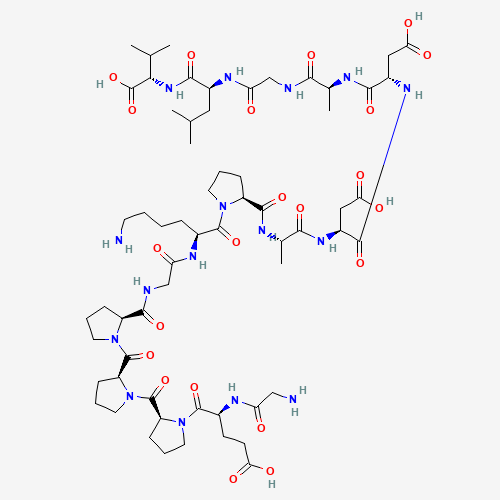
Last reviewed: October 2026 · Cleared Peptides research team
Research use only. BPC-157: Research Guide to the Pentadecapeptide is supplied for laboratory research. It is not a drug, food, cosmetic, or dietary supplement. It is not FDA-approved. It is not for human or veterinary administration. This page does not give a dose or a method of administration. A study cited on this page describes that study’s own test article. It does not make this lot an approved medicine. To check a fact, open the PubMed or DOI link, confirm the authors and year, and match the paper’s compound name, CAS number, or sequence to the specification table. The full method is on the research desk page. Identity and purity for a lot are only what that lot’s certificate of analysis reports. An HPLC percentage is not a sterility result and not an endotoxin result unless the certificate prints those tests.
BPC-157 (Body Protection Compound-157, also designated PL 14736) is a synthetic 15-amino-acid peptide whose sequence is derived from a protein found in gastric juice. It is one of the most widely studied short research peptides, used extensively in cell-culture and biochemical models.
In this guide:
BPC-157 Sequence and Identifiers
| Name | BPC-157 |
|---|---|
| Synonyms | Body Protection Compound-157; PL 14736; bepecin |
| CAS number | 137525-51-0 |
| PubChem CID | 9941957 |
| Molecular formula | C62H98N16O22 |
| Molecular weight | ≈1419.5 g/mol |
| Sequence | Gly-Glu-Pro-Pro-Pro-Gly-Lys-Pro-Ala-Asp-Asp-Ala-Gly-Leu-Val |
| Physical form | Lyophilized white powder |
Stability
BPC-157 is noted in the literature for unusual stability in aqueous solution and in gastric-juice-like conditions compared with many short peptides — a property attributed to its proline-rich N-terminal region. This stability makes it practical as a reference peptide in longer-duration in-vitro experiments.
Published In-Vitro Research Areas
- Endothelial and fibroblast cell-migration (scratch/wound-closure) assays
- Nitric-oxide (NO) pathway signaling
- Growth-factor receptor signaling, including VEGFR2 and FAK–paxillin pathway studies
- Gene-expression studies (e.g. growth-hormone receptor expression in fibroblasts)
These are laboratory research models; this guide makes no claims about effects in humans or animals.
Research Formats Available
BPC-157 is often studied alongside TB-500 (Thymosin Beta-4). Cleared Peptides offers BPC-157, a BPC-157 + TB-500 blend, and the multi-component GLOW and KLOW blends. Each lot’s COA is on our COA page. Compare the two peptides in our BPC-157 vs TB-500 guide.
Research materials referenced in this guide
Analytical testing notes for BPC-157
BPC-157 is identified in this guide as CAS 137525-51-0, formula C62H98N16O22, listed mass ≈1419.5 g/mol. The sequence recorded here is Gly-Glu-Pro-Pro-Pro-Gly-Lys-Pro-Ala-Asp-Asp-Ala-Gly-Leu-Val. An identity test compares a measurement with those values. A mass spectrum is the usual measurement for a peptide. FTIR, when a certificate uses it, is a supporting infrared fingerprint and is less specific for closely related sequences.
For BPC-157, routine chemical characterization is reversed-phase HPLC for area-percent purity and mass spectrometry for identity against the formula and mass in the table above. Oxidizable residues (cysteine, methionine, tryptophan) and deamidating residues (asparagine, glutamine), when the sequence contains them, are typical related-impurity questions for the chromatogram and the mass spectrum.
HPLC purity for this material is an area-percent result at the wavelength and gradient the laboratory states, commonly ultraviolet detection near 214 nm on a reversed-phase column. The instrument is a gradient pump, injector, column oven, and UV or diode-array detector. That percentage is not the number of milligrams in the vial. Water, acetate, trifluoroacetate, and other UV-silent material can dominate the gross weight while the purity figure stays high. Net peptide content, from an assay or amino-acid analysis, is the separate result to read when the certificate reports it.
A sterility test and an endotoxin test are not included in a chemical purity result. The compendial sterility test is a culture method (USP <71>): membrane filtration or direct inoculation into fluid thioglycollate medium and soybean-casein digest medium, incubated for 14 days. A PCR sterility screen uses a thermal cycler to detect microbial DNA and is a different method. The endotoxin test (USP <85> LAL, or USP <86> recombinant Factor C) reports endotoxin units with an incubating reader or a cartridge reader. Use a result only when that method is printed on the lot certificate. One published example in this catalog states that the report does not cover microbial contamination or endotoxins. The full description of equipment, standards, and how US laboratory accreditation works is in peptide analytical testing. Lot records are on the COA page.
Frequently Asked Questions
What is BPC-157?
BPC-157 is a synthetic 15-residue peptide (pentadecapeptide) derived from a gastric protein sequence, used as a research peptide in cell-based models.
What is the CAS number of BPC-157?
137525-51-0; formula C62H98N16O22, MW ≈1419.5 g/mol.
How should BPC-157 be stored?
Lyophilized BPC-157 is stored at −20 °C, sealed, dry and protected from light.
Is BPC-157 for human use?
No. Cleared Peptides supplies BPC-157 for laboratory research use only.
Written by the Cleared Peptides Research Desk, the editorial desk of Cleared Wellness Group LLC. This is not a personal profile of a physician or a scientist, and it is not a fictional author. The checking method is public on the research desk page. Last reviewed October 2026.
BPC-157 research note: a 15-residue sequence, and a concentrated literature
Research use only. This BPC-157 material is for laboratory research, CAS 137525-51-0. It is not a drug. The experimental literature summarized below is not a dosing guide, and this page does not provide one.
Identity first
The specification is the pentadecapeptide Gly-Glu-Pro-Pro-Pro-Gly-Lys-Pro-Ala-Asp-Asp-Ala-Gly-Leu-Val, formula C62H98N16O22, mass about 1419.5 g/mol. The sequence is short and proline-rich. It retains poorly on a plain C18 column unless the mobile phase uses an ion-pairing acid, and it has little absorbance at 280 nm, so 214 nm is the usual detection wavelength. Mass spectrometry is what distinguishes this sequence from another short peptide with a similar retention time. A “BPC” label without this mass is not this specification. The acetate or other counterion is invisible to an area-percent HPLC purity number.
Who wrote the body of papers, and why that matters
Most experimental reports on this sequence come from one research community, centered on Predrag Sikiric and Sven Seiwerth and their coworkers. Two reviews from that community are the secondary sources used here, because they state the scope of the claim in the authors’ own words.
Seiwerth, Rucman, Turkovic, and colleagues (Current Pharmaceutical Design, 2018) review BPC-157 against epidermal growth factor, fibroblast growth factor, and vascular endothelial growth factor, and they extend the discussion from gastrointestinal lesions to tendon, ligament, muscle, and bone models. The paper is a review of that group’s pharmacology, not an independent multi-center replication. PubMed 29998800, DOI 10.2174/1381612824666180712110447.
Seiwerth, Milavic, Vukojevic, and colleagues (Frontiers in Pharmacology, 2021) review the same peptide’s wound-healing literature, again from within that program. PubMed 34267654, DOI 10.3389/fphar.2021.627533.
A long reference list is not the same thing as many independent groups. When the same laboratories generate the lesion models, the peptide batches, and the reviews, a reader should weight the chemistry (sequence, mass, purity) more heavily than the volume of citations. This desk is not claiming the papers are false. It is claiming they should be read as a concentrated preclinical literature. Where a paper says “healing,” the subject is the animal or tissue model in that paper. It is not this vial, and it is not a human-use instruction. This note does not cite an outside replication, because the sources checked for this page did not add one that met the same standard. If you have a DOI from a separate group, the desk can add it after the same author-and-sequence check.
Not the same article as thymosin beta-4
BPC-157 and the 43-residue thymosin β4 protein sold as TB-500 are unrelated sequences. A blend does not inherit either review. See the comparison and the blend product, which has to show both masses.
How to verify this note
- Match the 15-residue sequence and CAS 137525-51-0. A shorter “BPC” fragment is a different molecule.
- Open both Seiwerth papers and look at the author list and affiliations. Count independent groups yourself rather than counting paragraphs.
- Keep any in-vivo result inside its model. Lot identity is the certificate.
Selected References
Peer-reviewed literature on the compounds discussed in this guide, listed as scientific background for laboratory researchers. Citation does not imply endorsement by the authors or any use other than in-vitro research.
- Sikiric P, et al. Stable gastric pentadecapeptide BPC 157-NO-system relation. Curr Pharm Des. 2014;20(7):1126-35. PubMed 23755725 · DOI
- Sikiric P, et al. Brain-gut Axis and Pentadecapeptide BPC 157: Theoretical and Practical Implications. Curr Neuropharmacol. 2016;14(8):857-865. PubMed 27138887 · DOI
Laboratory note: solubility depends on salt form and solvent. This guide does not state a single solubility figure. Handling of lyophilized material is described in the peptide storage guide.
Research Use Only Notice
This guide is provided for educational and laboratory reference purposes. It summarizes published, primarily in-vitro and structural research literature and does not describe, recommend or imply any use in humans or animals. Products sold by Cleared Peptides are for laboratory research use only; they are not drugs, foods, cosmetics or dietary supplements, are not FDA-approved, and are not intended to diagnose, treat, cure, mitigate or prevent any disease. No dosing, administration or therapeutic information is provided.
